
Just outside of town is the Fondation Maeght it is a renowned modern and contemporary art museum. It opened in 1964 and was founded by art dealers Aimé and Marguerite Maeght. The setting is stunning as is the architectural complex. It houses a collection of works artists such as Miró, Chagall, Giacometti, and Calder. It also features outdoor sculpture gardens. I could have spent the day it was so peaceful.
Day 14 May 22
This was a day of leisure so I went to the market. How many photos can you have of a market? You can’t have too many I’d say.
When shopping, the bread and pastries are easy to chose, but the cheese and meat are a different story. I decided to try Banon cheese, also known as Banon à la feuille. It is a traditional French cheese originating from the Banon region of France. It is crafted from unpasteurized goat’s milk.
It is easy to pick out because it comes wrapped in chestnut leaves.

How often do you see a big box of morels in the Farm Market? I purchased about 1 1/2 cups of morels and an equal amount of giant cherries, $12 for both! In the afternoon I taught a short course in watercolor painting to one of the ladies on the trip.


Aix en Provence
The historic area of Aix is not just a tourist area. In fact, there really aren’t that many typical souvenir shops. It’s where the locals shop as well as the tourists. And it is no exaggeration that there are 100 or more restaurants in a ten-block square.
There are also fabulous clothing shops, book stores, museums, historic sites, daily markets, art supply stores, and, of course, boulangeries and pâtisserie. This city is the perfect size, big enough to keep you busy but not so large that you’re going to feel lost or frustrated that you can’t see everything. It is also pretty flat so easy to walk.
Cezanne was born in Aix and lived most of his life there. Other famous artists that lived in the region are Van Gogh, Matisse, Chagall, Bonnard, and Renior to name a few. I can see why they were drawn here, the whole area is stunning.
The town of Aix en Provence has about 140,000 inhabitants with an additional 40,000 students at the University.


The city dates back to 122 BC when the Romans discovered the area’s natural hot springs. By the 5th century it became the capital of the region. And in 1182, it became the residence of the Counts of Provence, with new districts for artisans and merchants.
In the 15th century King René of Anjou attracted artists, musicians, and scholars to his court, creating a vibrant cultural scene. During this same period, a university was founded.

Despite its historical significance, Aix remained relatively untouched by the industrial revolution, preserving its traditional character. In the 20th century, the city experienced a cultural revival, with the establishment of institutions like the Grand Théâtre de Provence and the Cité du Livre, a center for literature and the arts. I’d been fretting about going to St. Paul de Vence. I was there on the artists trip in the ’90s and have dreamt about it ever since.
Day 15 St. Paul de Vence
It was getting harder to put two days together when there was not something already planned. I had decided I was not going to make the pilgrimage so was going to stay closer to Aix.
I walked down the hill to the car rental and was questioning the lady about what time I had to have the car back. She reminded me that I had it for 24 hours. I did not walk back up the hill to get a change of clothes or anything, on a whim I just took off for St. Paul!

The drive is about 1 3/4 of an hour. You change elevation up and down many times along the way and every now and then you see the Mediterranean. It’s not a bad drive and doesn’t get super busy until you get over toward Nice.
When I arrived in St. Paul, I found that they have a big four-story underground parking garage. When you emerge from it you are right at the gate to the city.
It was everything I remembered, many, many art galleries, restaurants, and shops on very narrow pedestrian streets.


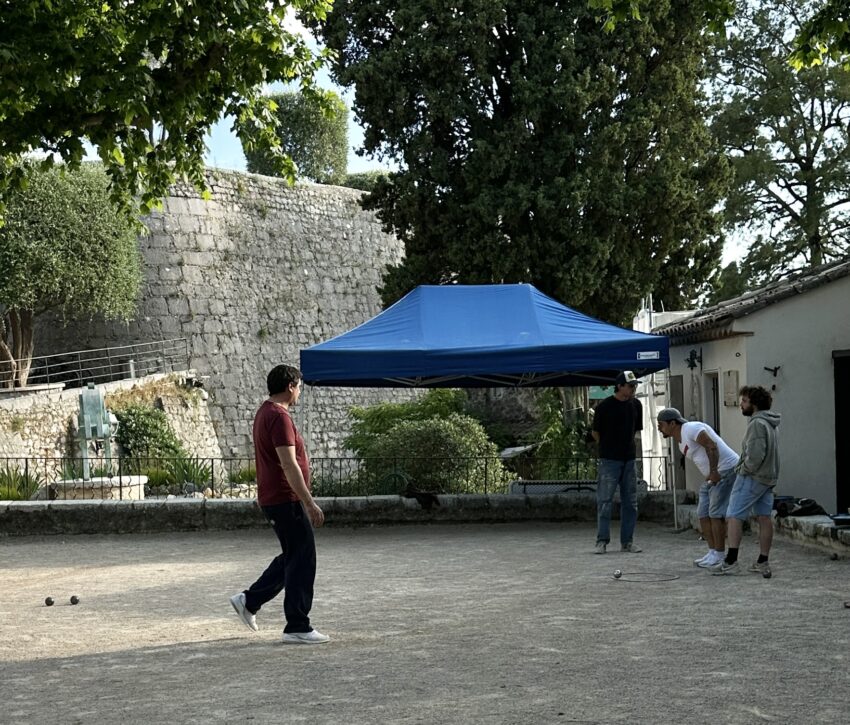
I came back in the evening after the tourists were gone. The locals gather every night to play Pétanque.
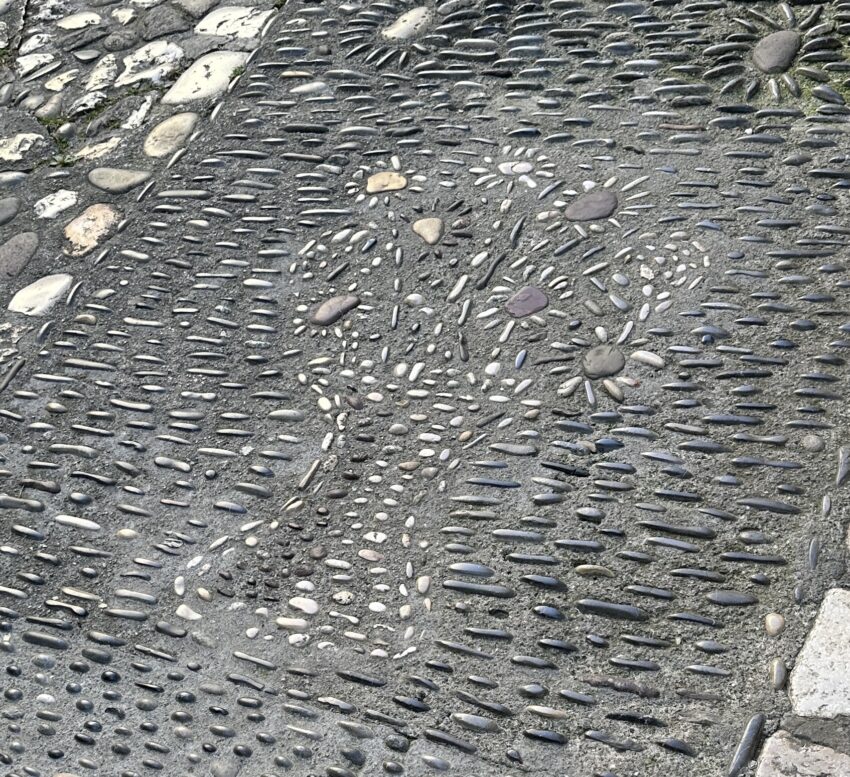
I love the stone walks. I saw a lot of these in southern Spain.
Fondation Maeght


But I had one more place I had to return to after 30+ years. I wondered if it would affect me the same way it did the first time. And it did.
Gourdon
Gourdon is also a hill town about 30 km from Vence. On that previous trip we were on a bus and the tour guide pointed up at the town perched high up on the cliff. The bus driver shook his head no, the guide shook her head yes, and up we went.
I had just gotten out of the car when I started hearing this loud ringing. I soon discovered it was a herd of sheep with bells around their necks. Hearing their bells was truly memorable.
The village is perched on a cliff about 2500 feet above sea level. It has been inhabited since prehistoric times. During the Middle Ages it became a fortified village.
It was ruled by various noble families and later the Lerins monks. The village is centered around a well-preserved medieval castle dating back to the 9th–12th centuries.
Today the population of Gourdon is 371.


From the village you could also see what they call the pre-Alps and the Mediterranean. But there was one more special place to see that night: my hotel. I had stopped at a rest area on the way and booked Le Hameau for that night.


I could do a half a dozen paintings of their grounds.
There was one hitch in the trip. I got up early to get the car back by 9. I left at 6:15 and its a 1-3/4 hour drive but I wanted to give myself extra time. A tire light came on and pointed to the passenger side rear tire and more or less said stop.
I didn’t think I would find a gas station with an attendant at that early hour but I did. The guy was very kind, helped me fill the tire, and said go to a service station right away, don’t go over 90km. One of the many reasons I always like to carry cash — so I could give this guy a tip for helping me.
I thought where would I find a service station on a Saturday at 6:15? So I took a deep breath and decided to try to make it back to Aix. I stopped several times to look at the tire.
About halfway home the light with the arrow came on again. There are service areas called “Aire de” (then the name of the area) along the toll road. Fortunately, they are about every 20 miles. So once again I asked a guy to help me, he was very nice too and was pleased to get a tip.
This time I made it back to Aix. The trip was worth the tire angst.
Day 16
I got home in time to go to the big market, it goes on and on, up main pedestrian street, The Cours Maribeau, 7 or 8 blocks mostly clothes — I could have bought a whole new wardrobe, cheap. Then it switches to jewelry, soap, and a few antiques. Then it switches to artists, then fish and meat, then it goes into the daily market of vegetables and the daily flower market.


I’m guessing it goes a mile. Food and flower markets are every day, the big market is Tuesday, Thursday, and Saturday. We visited the Caumont Museum where they were having a show of, guess who…. Niki!
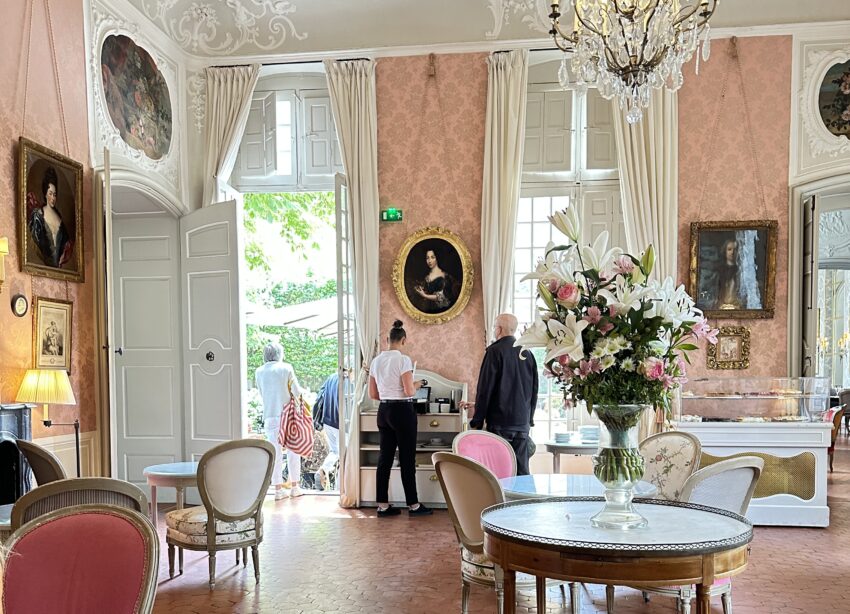
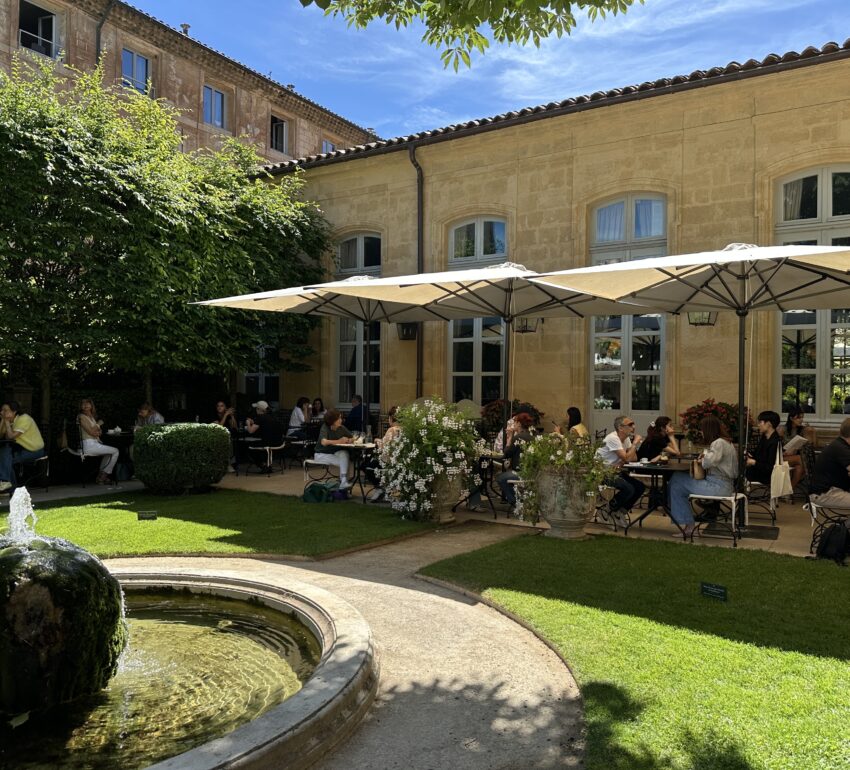
They also have a lovely courtyard cafe.
Dinner that night was a lovely asparagus panna cotta, Comté cheese, and Iberian ham, followed by poultry supreme, rosemary gravy, scalloped potatoes, hazelnut gratin, and, mille-feuille, vanilla ganache, strawberries, and passion fruit jelly.
Day 17 Avignon
At Avignon I opted out of touring the Palace of the Popes. I’m usually more interested in the exterior of a building than I am of the interior. Plus I have been inside before. And I did not feel like doing the 300 steps inside.
Instead I walked around the town, which I did not get a chance to do last time. The walls of the old city are pretty much intact but there has been little regard to keeping any kind of architectural harmony within the walls. There is a lot of new construction which kind of takes away from the ambiance.


The city was originally settled by Celtic tribes, and became a Roman colony in the 1st century BC. By the 4th century AD, Avignon had a bishop and was becoming an important Christian center.

The most famous chapter in its history, from 1309 to 1377, saw seven successive popes residing in Avignon instead of Rome. This was due to political instability in Italy. This is when the Palace of the Popes was built, one of the largest and most important medieval Gothic buildings in Europe.
We had lunch in a 650-year-old building then went to see the Pont du Gard.


The ancient Roman aqueduct was built in the first century AD to carry water over 31 miles to the Roman colony of Nemausus, now called Nimes.
Day 18 Aix
Lunch was great at Les Artists Cafe across from the Tourism office.


Coucous, zucinni strips, tomatoes, fresh peas, and fried cheese. Ice cream for dessert with strawberries. We then had a walking tour of Cezanne’s life in Aix.
This is a quick synopsis: He was born in 1839, out of wedlock, in Aix. His father started out as a hat maker and eventually became a successful banker. Cezanne attended College Bourbon and met writer Emile Zola. He and Zola would remain friends and supported one another until 1886.
Cezanne’s father insisted he study the law at the University of Aix en Provence but he continued to paint in his spare time. His father was not supportive of his art while his mother encouraged it. He submitted his work to the Salon in Paris many times but was consistently rejected.


He meet Pissarro, who became an important influence and he participated in the first Impressionist Exhibition.
By the 1880s he gradually moved away from Impressionism and developed his own approach. He finally married Hortense Fiquet, the mother of his child.
His father died and left him financially independent. He ended his long time friendship with Zola after Zola published a novel about a failed artist. Cezanne believed that the story was about him.
Cezanne painted up until a few days before his death.
As a post-impressionist his art influenced many movements.

After his father grew successful, he moved to the Jas de Bouffan House, which is currently under renovation.
Day 19 – Perfect Day of Leisure
I started the day with a massage and facial at a spa three blocks from the apartment.


Spa Thermes Sextius is one of the largest wellness facilities in the region. It is built over ancient Roman baths.
The town of Aix-en-Provence, or Aquae Sextiae by its Latin name, has always been renowned for its hot springs. It was for this very reason that the Romans decided to settle here.
The thermal baths were built in the second half of the 1st century at the top of the present-day Cours Sextius. If you schedule a treatment you can use the pool, steam, sauna, salt room, beautiful sitting areas, and whirlpool all day. The masseuse had a lighter touch than I prefer but the facial was perfect. The facility was beautiful.
I walked to the historic town which the apartment is on the edge of, had lunch, then strolled down some streets I had not been down yet. I was headed to the garden at the Musee Caumet when I spied “Book in Bar.”


It is an international book store with a small cafe. The first floor is mostly English books and upstairs every other language. I sat for a while drinking a milkshake and read the NY Times. I have a hard time getting out of a bookstore without buying something.
I chose “Strolling the Streets, Aix en Provence” and “On Doing Nothing — Finding Inspiration in Idleness.” The first book describes what I’m good at, the second I’m not good at, doing nothing. Back at the apartment I laid in the sun on a comfy couch in the courtyard and read. It was a perfect day!
Day 20- Arles
Our first stop in Arles was at the Musee Departmental Arles Antique. The museum contains antiquities found in excavations in the Area. The collection spans the period from approximately 2500 BC through the Greeks and Romans. Many pieces were found in underground tombs carved into the rock. The collection was astounding.


One unusual piece was discovered in 2004 and lifted out of the River Rhône. It’s a 100-foot-long barge that dates from the 1st century BC.
There is an amphitheater which was built by the Romans. For more than 400 years, gladiators and chariot races were held there. It was designed after Rome’s Coliseum and built in 90 AD.
It is right next door to the Ancient Theater of Arles. This theater stands as one of the earliest stone theaters in the Roman world. Its construction began around 40/30 BC and was completed around 12 BC, shortly after the establishment of the Roman colony.


Of course I was particularly interested in seeing where Van Gogh painted and lived. Many consider Van Gogh’s Arles period to be the most creative of his career. Many of Van Gogh’s best-known works were produced during his time here. It’s odd that the Van Gogh Cafe is not open. I would think they could make a fortune. Everyone that goes to Arles because of Van Gogh would HAVE to eat there.
We also visited the courtyard of the former Arles hospital, now named “Espace Van Gogh”. Built in the 16th century, the Hôtel-Dieu originally served as a hospital. In 1888, after the incident with his ear, Van Gogh was admitted here and spent several weeks recovering. During his stay he was inspired by the courtyard gardens.

The hospital closed in 1974 and was later restored to become a cultural space. The renovation recreated the gardens as they appeared in Van Gogh’s paintings.
The garden is framed on all four sides by buildings of the complex.


Aix and its Fountains
There are approximately 250 public and private fountains scattered throughout the city. This concentration is among the highest in Europe. The name “Aix en Provence” means “waters in the Roman Province.” It comes from the original Latin name given to the city by the Romans.
The original name was Aquae Sextiae, or “waters of Sextius,” after the Roman consul who founded the city. Some of my favorite fountains are Fontaine de la Rotonde – commissioned by the city in 1860. The three figures on the top depict the town’s central business pursuits: justice, agriculture. and fine arts.

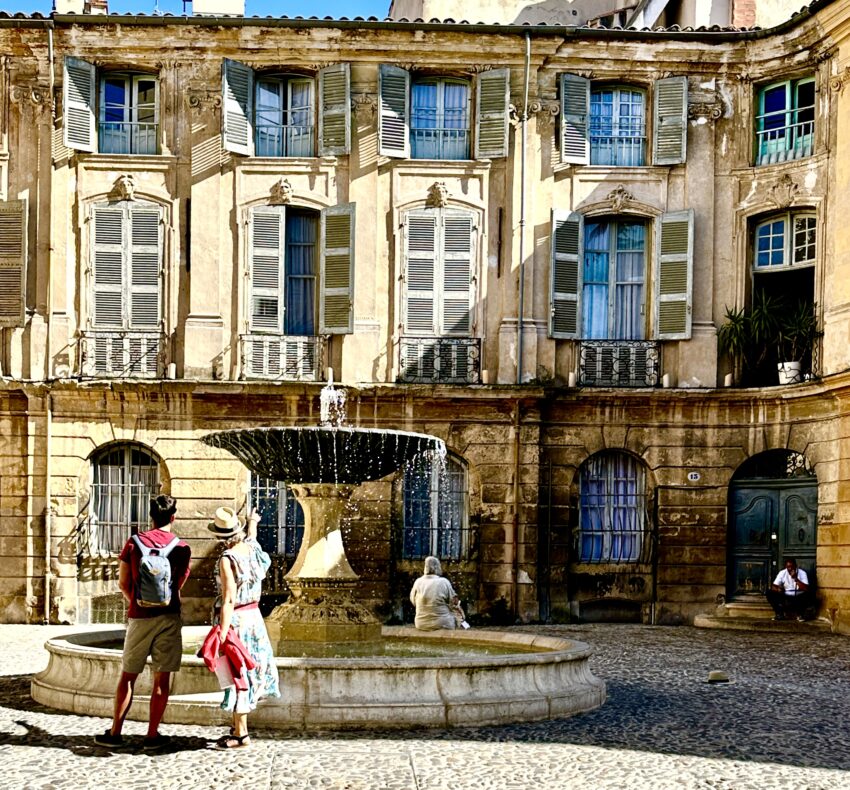
D’Albertas Fountain
In the 18th century the Albertas were one of the city’s leading families. They owned the property across the street and tore down a building where the fountain sits so they could have more light.
Hotel de Ville Fountain
Built in 1756, its base supports a Roman column that comes from the ruins of the count’s palace.
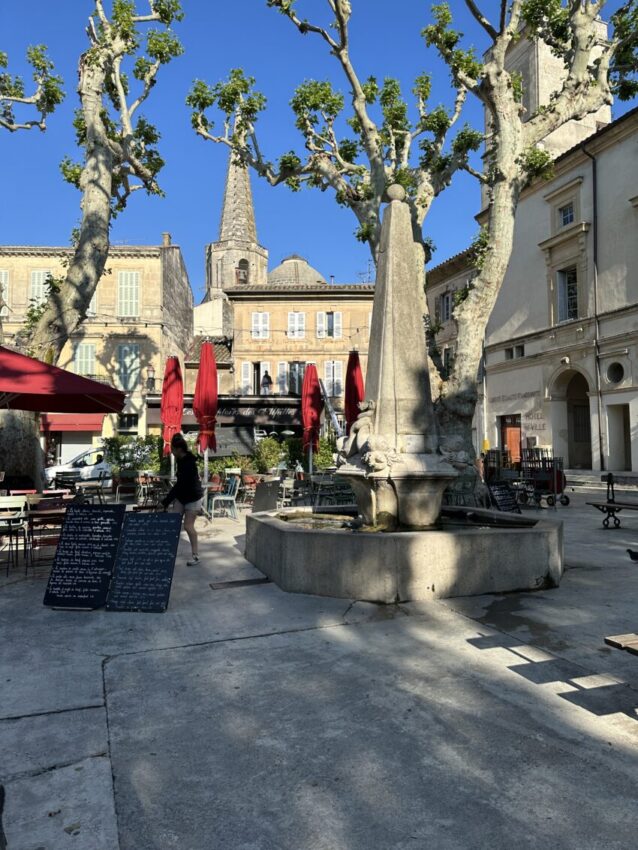
It has a recessed four-sided stone basin and marble plaques engraved in Latin to the glory of King Louis XV, the Duke of Villars .
And the four macaroons through which the water flows symbolize hygiene after the plague of 1720.
During the Revolution, in 1789, the city was organized into arrondissements based on this fountain.
Behind the fountain the City Hall tower sits above a gate that was the entrance to the Roman military outpost of Sextius.
The hourly clock, and the astronomical clock, on the tower, date from 1661. There are 4 wooden figures that appear in turn, for the seasons.
The Fountain of the Four Dolphins
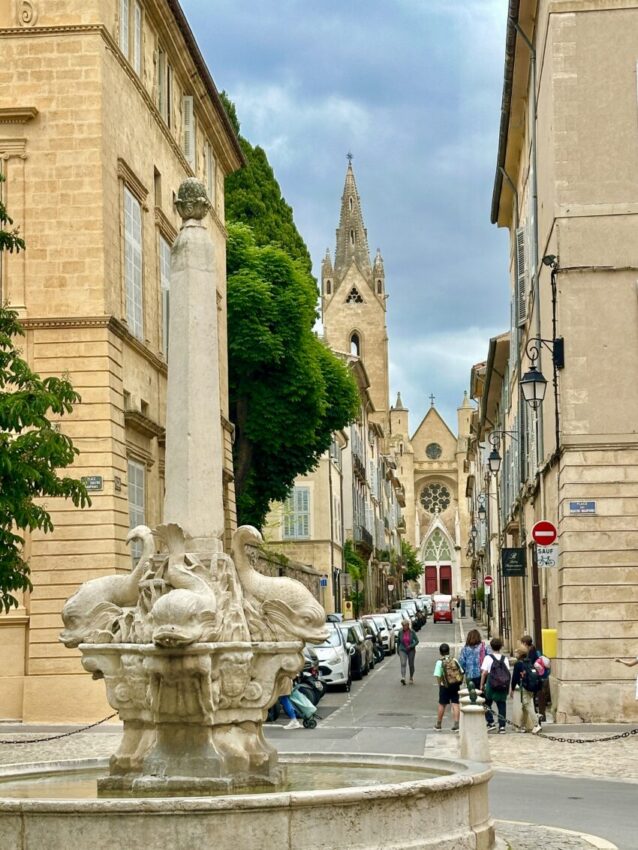
Next to the The Fountaine de la Rotonda The fountain of the Four Dolphins is probably the most famous.
The fountain in the middle of the square shows four ornate dolphins around a pyramid supporting a column holding a pine cone.
The dolphins spout water into a large circular pool below. It was built in 1667.
There are so many fountains it is hard to chose a favorite.
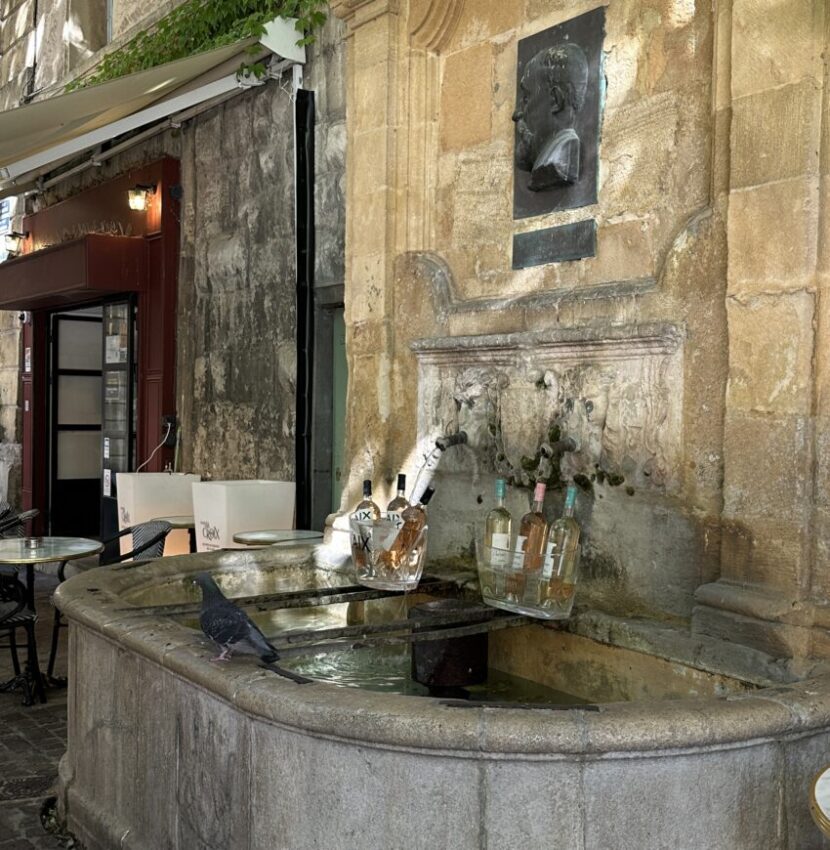
I do like the one that is used to chill wine!
That evening I went to dinner in a large square that holds a dozen restaurants and they were all full. Everyone dining outside under the stars.
Day 21
Another leisure day. After a late start I went back to the cafe and garden at the Caumont Center for the Arts. And that evening had a great meal at Le Jardin de Mazarin. I failed to get photos!
Day 22 Field of the Painters
I got an early start and rode Bus #5 to Field of the Painters. This was one of Cezanne’s favorite spots to work on the paintings of mountain Sainte Victoire. He did 17 paintings in watercolor and 11 paintings in oil from this vantage point.
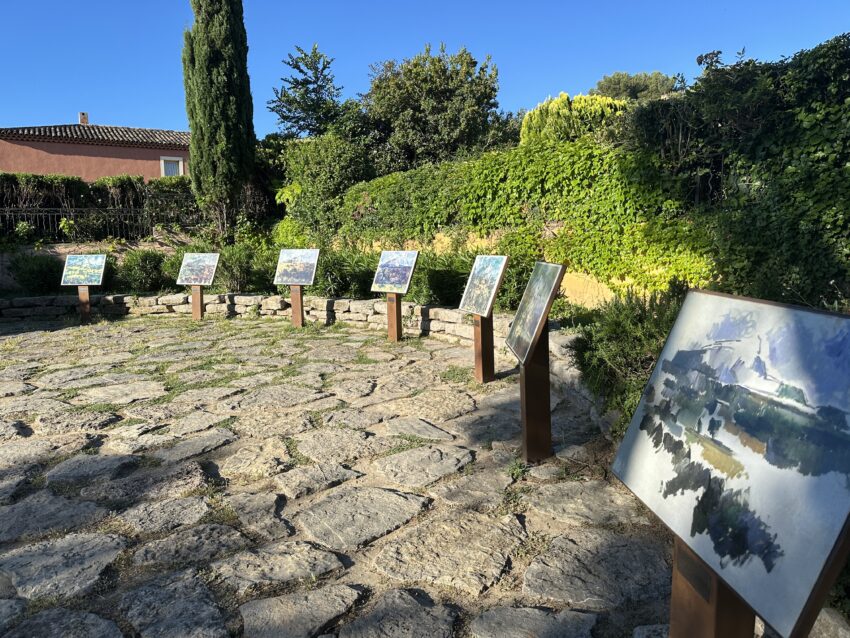
From the street you climb quite a few steps to get up to the monument. I was the only one there, it was so peaceful. In the garden there are reproductions of 8 of his paintings in the exact location where they were painted.
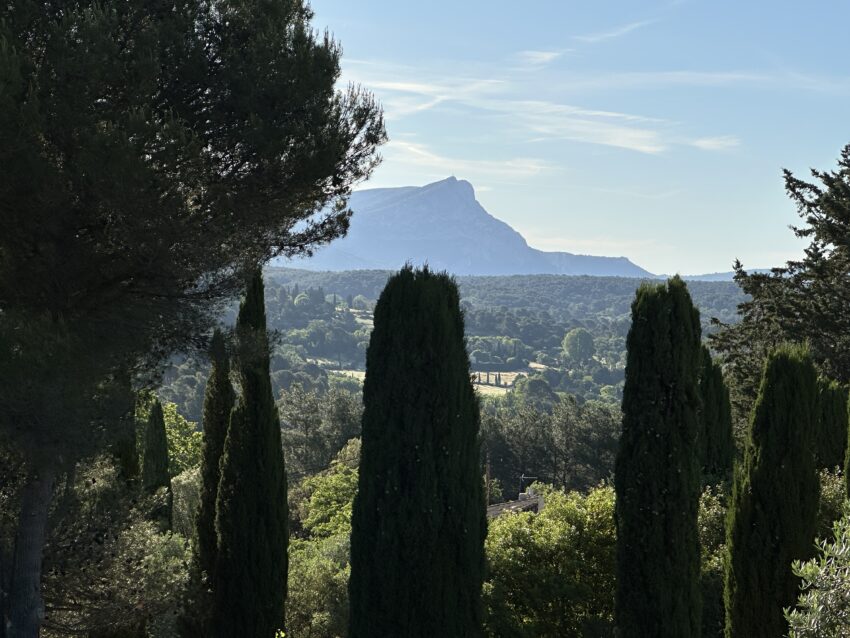
Then I walked back to town, it’s 1 1/2 miles. I didn’t walk TO the monument because it was up hill the whole way.
On the way back to my apartment I passed Atelier des Lauves, a studio Cezanne had built. They say it’s just a ten-minute walk from the studio to the Field of the Painters, but again, it’s uphill. The last part you are really climbing. I can’t image hauling all my painting equipment up that hill. By the time he built the studio he was well off so maybe he had help.
Unfortunately, the studio is under renovation and is covered with scaffolding so I could not get a photo. But down the street a bit was a photo of what it once looked like. Now it is behind a high wall.
A little further down the hill I caught this great shot out of the corner of my eye. When you hear talk about the light in the south of France, this represents it.


And a bit further I found this monument to Joseph Sec. The monument was built In 1792. It is crowned by the figure of Revolutionary Justice, which stands above the representation of Moses delivering the Law. The statuary within the garden represent Old Testament figures such as Noah with an ark and David with the head of Golaith.
Once I got back into the historic district I visited the Tapestry Museum. The building was the former Archbishop’s Palace. It became the “Museum of Tapestries” in 1909. It’s a huge building composed of four wings framing an inner courtyard.


The courtyard is where In 1949 a festival of Lyrical Art dedicated to Mozart was started. It is one of the most famous open-air theaters in Europe. They were setting up for the upcoming Opera festival when I was there.


The Palace houses collection of tapestries from the 17th and 18th centuries. I will have to admit I was more interested in the costume displays and the piece of stage set. The costumes were all from operas. They had photos of the performances and drawings of the costumes with swatches of fabric. And in some cases the costumes themselves.
The Cathedral of Saint Sauveur is just a few steps away.
The cathedral is built on the site of the 1st-century Roman Forum of Aix. It was built and rebuilt from the 12th century until the 19th century. It includes Romanesque, Gothic, and Neo-Gothic elements. There are also Roman columns and parts of the bapistery from a 6th-century Christian Church. It is a national monument of France.
That evening I went with two other ladies from NC, both artists, to the studio of Jill Steenhuis. Jill is an American artist that has been living and painting in France for 40 years. She teaches painting workshops and was having a party for her current class. She had a great band, good food, and lots of nice people, both Americans and French. Her home and studio are in the country about ten miles south of the city. I loved her huge studio! Interesting that throughout France 95% of the music I heard was American.


Week 4 and Home post, coming soon!

Oh my! I almost missed week 3???
I saw a post for week four and had to go back. I must have been asleep at the wheel ?
This week looked even better than the last! My favourite (Canadian spelling ?) so far….
Thank you Clayton. The whole thing was great. Could have stayed a few more weeks. Every week I learned of something more I wanted to do or another place I wanted to go. I’ve been studying french but may be able to speak it but don’t that I’ll ever understand someone speaking to me. That is a real handicap. Yes I could get by visiting but long term i think it would be very isolating. Heavy sigh! Happy to say heard of no one in the group of 28 being of the opposite political persuasion. Thanks for reading and commenting!!